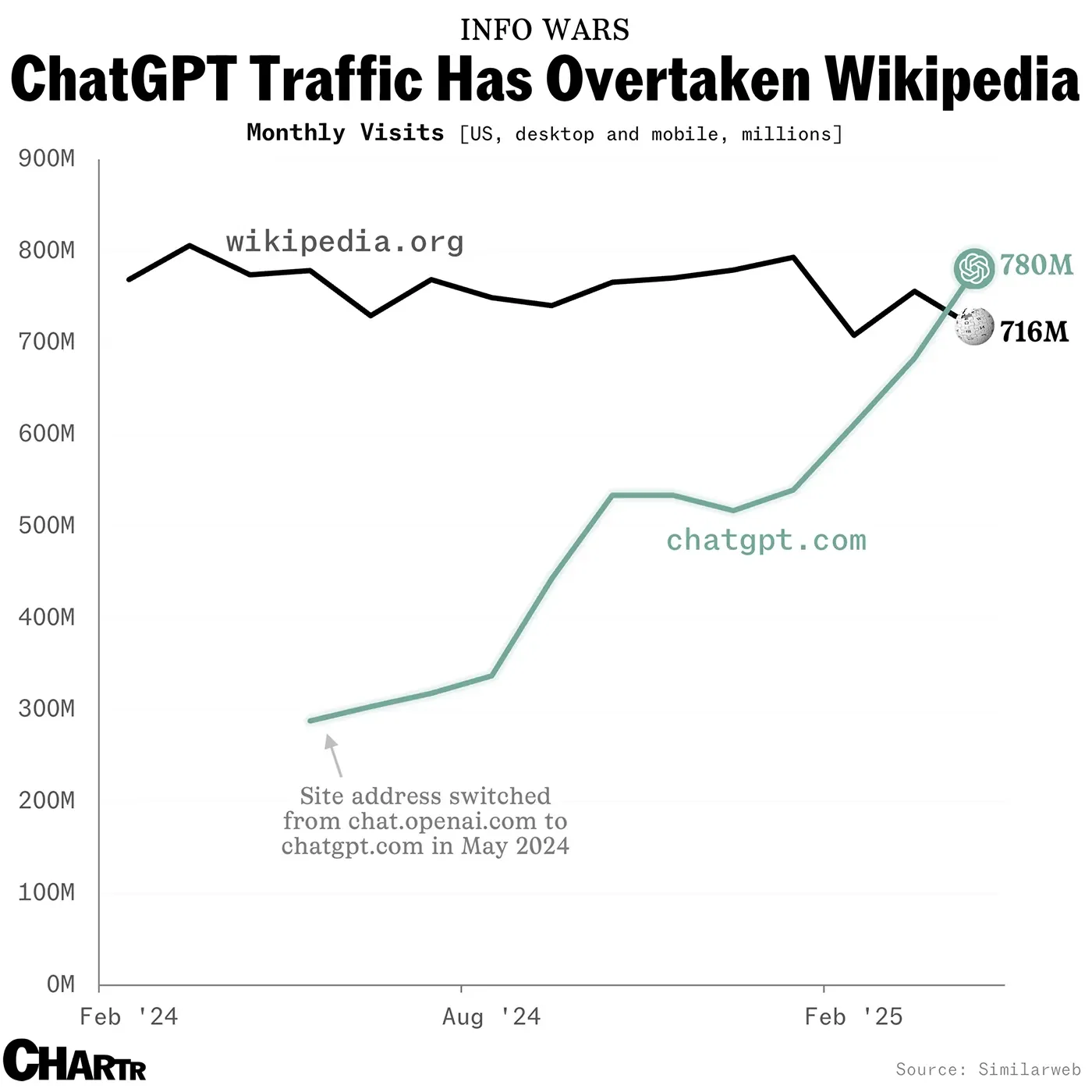
The digital landscape is shifting again, and this time, it’s happening at the top of the funnel. Recent data from Similarweb reveal a fascinating trend: users are turning to ChatGPT rather than Wikipedia for information. For digital marketers and business owners, this signals a critical shift in how people are seeking, consuming, and trusting information online.
At Brandlective, we’ve always said that staying visible isn’t just about climbing the rankings on Google, it’s about being present where your audience actually is.
And if the latest user behaviour is anything to go by, that place is increasingly behind the chat window of an AI tool, not a traditional webpage.
The Changing Nature of Search
When the web first exploded, Wikipedia became the go-to source for quick, crowd-sourced knowledge. But in 2024, ChatGPT surpassed Wikipedia in direct traffic from search. According to Similarweb’s latest findings:
- ChatGPT saw over 1.8 billion visits per month, outpacing Wikipedia for several consecutive months.
- A growing number of users now bypass Google altogether, heading straight to AI chat interfaces for answers.
This trend reflects a deeper shift: users want speed, summarisation, and simplicity. They want a direct answer, not a deep dive into 10 blue links or a thousand-word encyclopaedic page.
But that raises some important questions—chief among them: what happens to accuracy and content attribution?
ChatGPT vs Wikipedia: Accuracy and Authority
Wikipedia, for all its flaws, is at least grounded in verifiable, sourced content. It may be edited by volunteers, but it’s subject to community review and reference-based moderation. ChatGPT, on the other hand, generates responses based on probabilistic language models, not real-time fact-checking.
That means:
- There’s no guarantee of accuracy
- Information may be outdated, particularly if users rely on free models that haven’t been trained on recent data
- Sources often aren’t cited unless prompted
From an SEO and marketing standpoint, this matters because:
- Trust in information impacts consumer decision-making
- Misinformation or vague content could affect brand reputation
- The authority once held by traditional content platforms is now shared—or even overshadowed—by generative AI tools
The result? A more fluid information environment. Consumers may be more influenced by what an AI chatbot says than by what your carefully optimised web page presents. Whether that’s fair or not, it’s happening.
What This Means for SEO and Web Traffic
The shift towards conversational AI interfaces has direct implications for SEO:
Organic Traffic Is at Risk
When users get their answers directly from ChatGPT or similar tools, they may never click through to your website. Even if your content is used as source material, you may receive zero visibility or attribution.
This is similar to the “zero-click” phenomenon we’ve seen with Google’s featured snippets—but on steroids.
Keyword Strategy Needs to Adapt
Traditional SEO relies on targeting keywords and ranking for them on search engines. But in an AI-first world, the value lies in structured, AI-readable content that’s semantically rich and contextually accurate.
Optimising for a chatbot response means:
- Including clear definitions and explanations
- Structuring your content in a question-and-answer format
- Using schema markup to help AI models understand your content more easily
Topical Authority Matters More Than Ever
Generative AI tools tend to favour sources that consistently publish high-quality, relevant content. In other words, brands that demonstrate topical authority are more likely to be cited—even indirectly—by AI tools.
If you’ve been treating content marketing as an afterthought, now’s the time to reverse that mindset.
So… What Should Businesses Do?
Whether you’re a SaaS company, a healthcare provider, or an e-commerce brand, this changing information ecosystem demands a proactive strategy. Here’s how we recommend responding at Brandlective:
1. Prioritise First-Party Data
With the rise of AI tools using scraped web content to generate answers, businesses must double down on their owned data. That includes:
- Building and maintaining strong email lists
- Developing exclusive tools, calculators, or resources
- Creating gated content that can’t be easily scraped by AI bots
You want content that drives traffic because it’s unique, timely, and unavailable elsewhere.
Great! But how can you apply this in the real world? A private dermatology clinic could launch a “Skin Health Tracker” on its website—an interactive tool that allows users to input symptoms, track flare-ups, and receive personalised advice based on skin type or condition (e.g., acne, rosacea, eczema). Users must sign up with their email to use it, building a valuable, GDPR-compliant database of qualified leads. The clinic can then follow up with relevant content or appointment reminders, all while controlling this data directly—no reliance on third-party cookies or algorithms.
2. Publish with Purpose
Not all content needs to be 2,000 words long, but it does need to be genuinely helpful. Shift away from keyword stuffing and towards:
- Deeply researched, expert-led content
- Case studies and unique insights
- FAQs, glossary sections, and user intent-matched articles
These not only serve real humans but are also well-suited to becoming training data for future AI models.
Our recommendation here at Bandlective for a wellness brand offering gut health supplements would be to create a monthly expert-led blog series written by registered dietitians or functional medicine practitioners. Instead of generic listicles, posts could focus on real patient case studies, research-backed explanations, and common misconceptions (“The Truth About Probiotics and IBS”). They could also include downloadable PDF guides and short videos for visual learners, positioning the company as a go-to source of credible information in a sea of AI-generated fluff.
3. Monitor AI Mentions and Reputation
Just like you’d monitor your brand mentions on Google or social media, you’ll need to start tracking how AI tools mention (or misrepresent) your business. For example:
- Test prompts like “What does [your brand] do?”
- Check summaries of your products or services
- Flag and report inaccuracies if possible
This form of AI reputation management is still emerging, but it’s rapidly becoming essential.
What does this look like in a real-world example? Well, a telehealth provider could regularly test ChatGPT and other AI tools by prompting queries like:
-
“Is [Company Name] a legitimate healthcare provider?”
-
“What services does [Company Name] offer?”
-
“Who are the founders of [Company Name]?”
If the AI returns inaccurate or outdated info, the company could adjust its “About” page, FAQs, or meta descriptions, and ensure that key info is structured for discoverability. They might also launch a press release or digital PR campaign to reinforce their authority, making sure accurate data is publicly available for AI tools to reference.
4. Optimise for Conversational Search
Tools like ChatGPT, Perplexity, and Google’s Search Generative Experience (SGE) are conversational by nature. This changes how your content needs to be written:
- Use natural language and long-tail questions
- Write in a tone that sounds helpful, not corporate
- Answer follow-up questions a user might naturally ask
Your goal is to become the go-to source for AI tools looking to summarise or cite expertise.
At Brandlective, we have recently consulted for a mental health platform offering online therapy and one ideas was that they could build a comprehensive Q&A library with titles like:
-
“What’s the difference between CBT and DBT?”
-
“How much does online therapy cost in the UK?”
-
“Is online counselling confidential?”
Each answer would be conversational, clear, and SEO-friendly, designed both for human readers and AI tools to summarise easily. They could also add voice search optimisation and schema markup so smart assistants (e.g., Alexa, Siri) can read their answers aloud.
A Word on Attribution and the Future of the Web
There’s a brewing ethical conversation about whether AI tools should attribute and link to the websites they summarise or draw from. Google’s SGE is taking baby steps in this direction. OpenAI and others are exploring partnerships and licensing.
But for now, it’s still a grey area.
As a result, brands must work even harder to make their originality, personality, and trust signals impossible to ignore. That includes:
- Developing a distinctive tone of voice
- Featuring real team members and case studies
- Building backlinks and digital PR to boost domain authority
In short: don’t just be another blog in the sea of sameness. Be the brand that AI wants to cite because you’re the gold standard.
Don’t Panic—Plan
Yes, ChatGPT is disrupting how people search. Yes, traditional web traffic models are under threat. But this isn’t the death of SEO—it’s the next evolution.
Much like the shift from print to digital or from desktop to mobile, businesses that adapt will survive—and thrive. Those who bury their heads in the sand won’t just lose traffic. They’ll lose relevance.
At Brandlective, we’re helping our clients plan for this future now:
- Reassessing keyword strategies
- Creating AI-ready, evergreen content
- Building visibility in a world where search is no longer just Google
If you’re not sure where your brand stands in this new landscape, let’s talk. The next era of digital visibility is here—and it’s not waiting for anyone.
Want to future-proof your visibility?
Let’s audit your content and uncover where your site stands in the AI-powered search landscape. Book a strategy call with Brandlective today.