A Plain-English Guide for Business Owners (And Why They Matter More Than You Think)
Search is changing — quietly, but fundamentally.
For years, businesses were told that success online meant ranking on Google, driving traffic, and competing for keywords. That world hasn’t disappeared, but it is no longer the whole picture.
Today, people don’t just search.
They ask.
They ask Google.
They ask ChatGPT.
They ask Perplexity.
They ask voice assistants.
They ask AI tools built directly into browsers, phones, and operating systems.
And increasingly, they don’t even click through to websites.
This is where AEO and GEO come in.
As a ‘Best London SEO agency’, we’re having this conversation with almost every client right now because the businesses that adapt early will remain visible, credible, and chosen. Those that don’t will slowly fade into the background, even if their websites still “rank”.
Let’s break this down properly, without jargon.
The Shift: From Search Engines to Answer Engines
Traditional SEO was built around one core behaviour:
Someone types a query → Google shows links → the user chooses one
AI-driven search changes that flow completely:
Someone asks a question → AI generates an answer → sources may or may not be clicked
That answer is shaped by:
-
What content exists online
-
How clearly it explains things
-
Whether it feels trustworthy
-
Whether it aligns with wider consensus
This is no longer just about keywords.
It’s about understanding.
What Is AEO (Answer Engine Optimisation)?
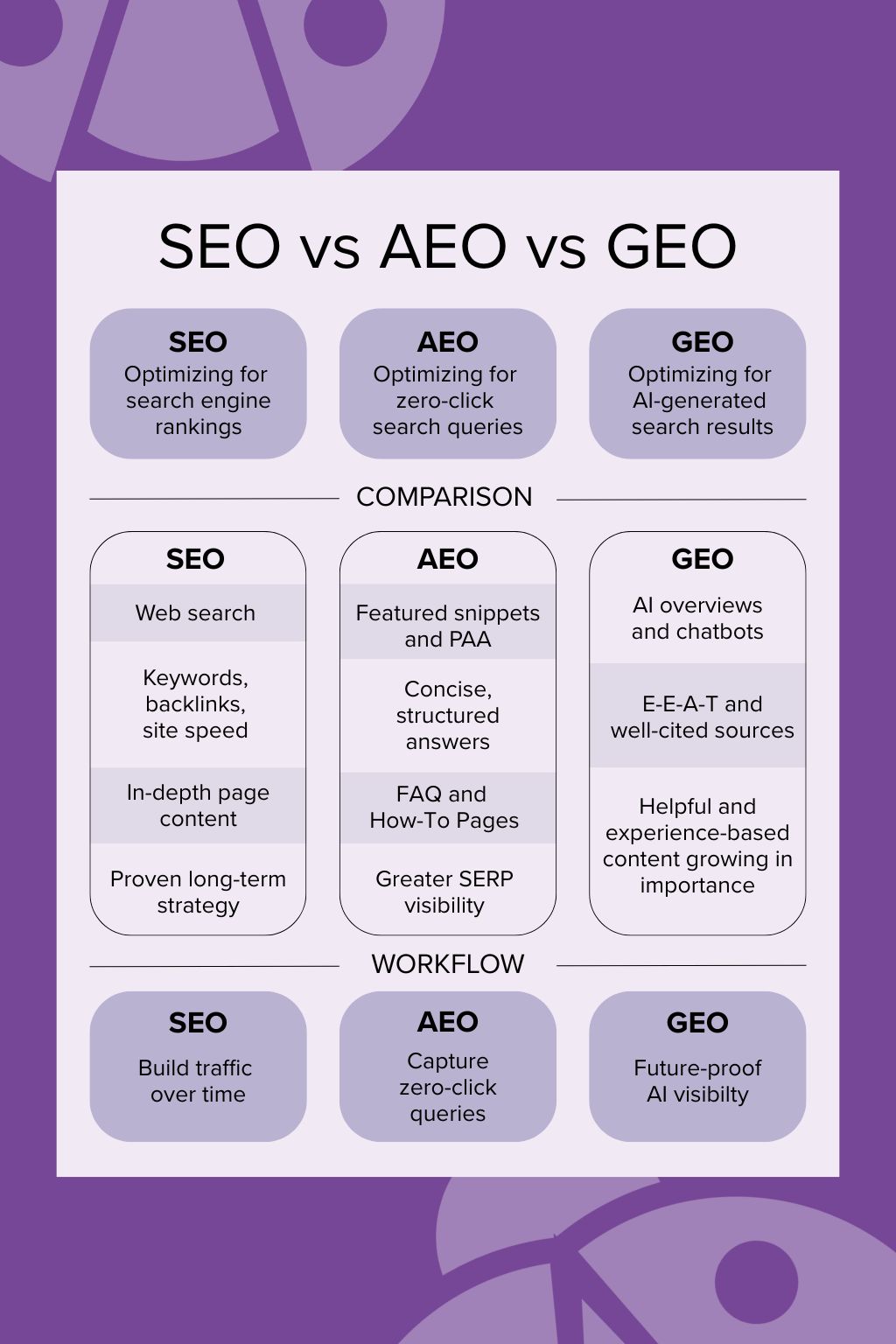
AEO is about helping AI answer questions clearly and accurately using your content.
Think of AEO as:
-
Structuring your website so answers are obvious
-
Reducing ambiguity
-
Writing the way humans speak, not the way marketers optimise
-
Anticipating real questions and answering them directly
If SEO was about ranking, AEO is about being useful.
A Simple Example
Traditional SEO thinking:
“We want to rank for ‘London SEO agency’”
AEO thinking:
“What questions does someone ask before they choose a London SEO agency?”
Such as:
-
Is SEO still worth it in 2026?
-
How long does SEO actually take?
-
Why do agencies promise results they can’t guarantee?
-
How do I know if an SEO agency is trustworthy?
AEO ensures your website answers these questions clearly, in language that AI can extract and reuse.
That’s how your business appears in:
-
Featured answers
-
AI summaries
-
Voice responses
-
Zero-click search results
What Is GEO (Generative Engine Optimisation)?
If AEO is about answers, GEO is about understanding and trust.
GEO influences how AI systems understand your brand, your industry, and your credibility over time.
GEO focuses on:
-
Context
-
Sentiment
-
Consistency
-
Reputation
-
How others talk about you — not just what you say about yourself
AI doesn’t learn from one webpage.
It learns from patterns.
That includes:
-
Your website
-
Reviews
-
Thought leadership
-
Third-party discussions
-
Forums, articles, comparisons, and commentary
GEO is about shaping that big picture.
AEO vs GEO: The Simplest Way to Think About It
-
AEO = Can AI clearly answer questions using your content?
-
GEO = Does AI trust your brand and understand where you fit?
You need both.
You can have excellent AEO and still struggle if:
-
Reviews contradict your messaging
-
Industry discussions are sceptical
-
Your positioning isn’t consistent
And you can have strong GEO signals but fail to appear if your content isn’t structured clearly enough to be used as an answer.
Why This Matters for Every Business… Not Just Tech Companies
This isn’t a trend for “digital brands only”.
If you sell:
-
Professional services
-
Healthcare
-
Recruitment
-
Consulting
-
Property
-
Education
-
B2B services
-
High-value or trust-led offerings
…then AEO and GEO matter deeply.
Why?
Because AI tools are increasingly used at the decision-making stage, not just discovery.
People are asking:
-
Who should I trust?
-
What’s the safest option?
-
What do people like me choose?
If AI can’t confidently include your business in that answer, you’re invisible, regardless of how good your service is.
How Businesses Should Adapt Their Websites for AEO
You don’t need to rebuild everything, but you do need to think differently.
1. Move From Keywords to Questions
Instead of only targeting phrases, structure content around:
-
FAQs
-
Plain-English explanations
-
“How it works” sections
-
Transparent pricing logic
-
Honest limitations
2. Make Answers Obvious
AI struggles with:
-
Vague marketing language
-
Over-designed pages with no substance
-
Content that dances around the point
Clear headings, short paragraphs, and direct answers are essential.
3. Reduce Ambiguity
If something varies, explain why.
If results depend on factors, state them.
If timelines differ, give ranges and reasoning.
Clarity builds trust — for humans and machines.
How Businesses Should Adapt for GEO
GEO is broader and longer-term.
It asks:
“If AI looks at the entire internet, does your brand feel credible?”
That includes:
1. Consistent Messaging Everywhere
Your website, LinkedIn, articles, interviews, reviews, and discussions should broadly reinforce the same truths.
Contradictions weaken authority.
2. Thought Leadership, Not Promotion
AI favours:
-
Explanations
-
Education
-
Nuance
-
Balanced perspectives
Over-salesy content doesn’t age well in AI systems.
3. Real-World Validation
This includes:
-
Reviews
-
Mentions
-
Commentary
-
Case studies
-
Industry discussion
AI wants to see that your expertise exists outside your own website.
Why “Best London SEO Agency” Is No Longer Just a Ranking Goal
Historically, businesses (like us) wanted to rank for phrases like Best London SEO agency.
Today, the real goal is different.
You want AI to confidently explain:
-
Who the best agencies are for different types of businesses
-
Why certain agencies are trusted
-
What makes one approach more suitable than another
That confidence comes from:
-
AEO clarity on your site
-
GEO consistency across the wider web
This is why working with the Best London SEO agency today looks very different from five years ago.
There Are No Quick Wins — And That’s Important to Say
AEO and GEO are long-game strategies, just like SEO always was.
There is no switch you can flick.
No shortcut.
No hack.
As Stacey Kehoe, Communications Director at Brandlective, often explains:
“Just like traditional SEO, AEO and GEO reward clarity, consistency and patience. The businesses that win are the ones willing to think deeply about how they’re understood, not just how they’re seen.”
That mindset shift is where most businesses struggle.
What This Means Practically for Business Owners
If you take one thing away, let it be this:
Visibility in the AI era is about being understood, not just being found.
Practical first steps:
-
Audit your site for unanswered questions
-
Add FAQs based on real customer conversations
-
Simplify your language
-
Align messaging across platforms
-
Invest in content that explains, not just sells
Relevance Is Earned, Not Optimised
Search is no longer a technical game alone.
It’s a trust exercise.
AI systems are trying to replicate human judgement at scale, and they rely on clarity, consistency, and consensus to do it.
The businesses that remain relevant will be the ones that:
-
Explain themselves clearly
-
Accept nuance
-
Participate in honest conversations
-
Build credibility over time
AEO and GEO aren’t the future of SEO.
They’re the natural evolution of it.
And the earlier you adapt, the more visible and trusted your brand will remain.