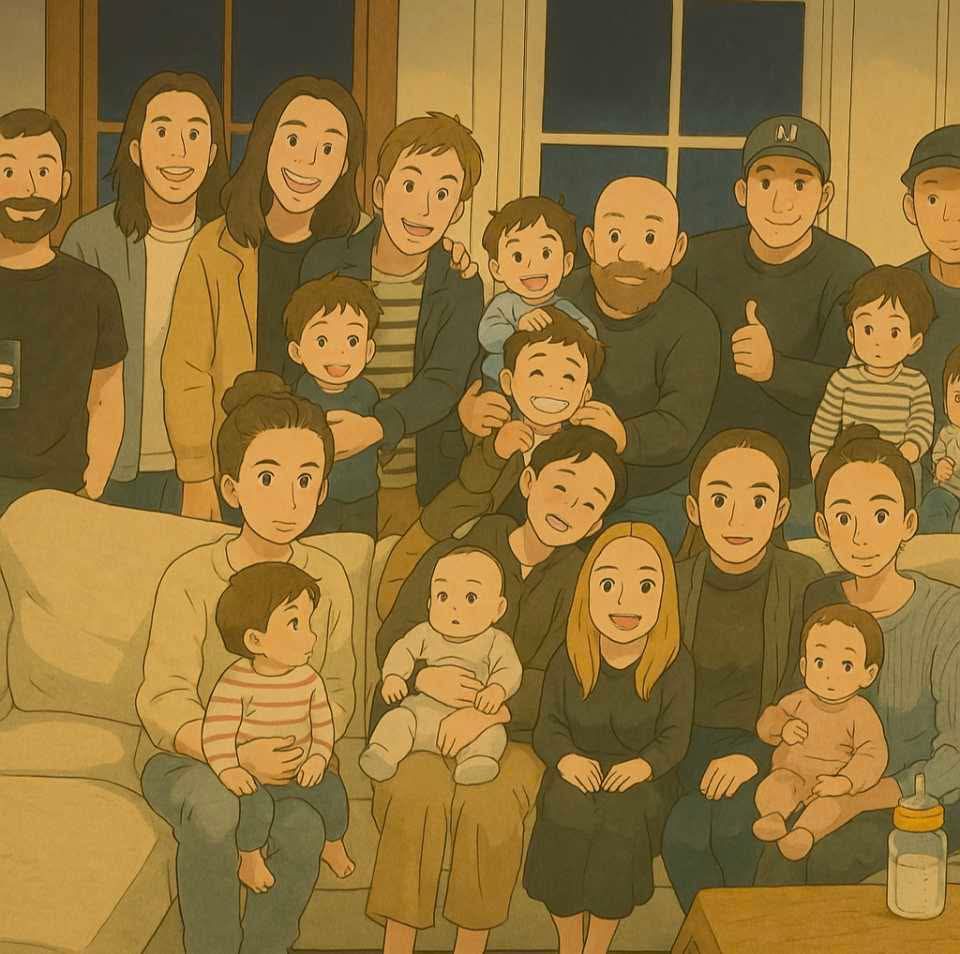
The Ghibli AI trend is everywhere right now. If you’ve spent any time on social media in the last week, you’ve probably seen it: people turning themselves, their families, and even their pets into dreamy, hand-drawn characters that look like they were plucked straight from a Studio Ghibli film. It’s adorable, nostalgic, and has completely captivated people — so much so that it reportedly almost overwhelmed the OpenAI servers.
But even in their playfulness, these images highlight something deeper: how AI interprets what it sees, and what cultural assumptions are embedded in its design.
Our founder, Stacey, uploaded a photo of her multicultural family — and the results were more unsettling than enchanting. Everyone in the image was made to look of white European descent (not a reflection of this very multi-cultural family). And all of the children? Turned into young boys.
It’s moments like these that shine a light on something we’re not talking about enough:
AI bias is baked into the content we consume every day.
The Rise of AI-Generated Content
We’re seeing more AI-generated videos, images, and copy across our feeds than ever before. And most of it is designed to look just human enough to pass the scroll test.
In fact, this influx of synthetic content is fueling a theory called the Dead Internet Theory — the idea that somewhere around 2017, the real internet died, and what we’re seeing now is mostly content created by bots, algorithms, and AI. While the theory is extreme, the underlying concern is valid: we’re consuming a lot more automated content than we realise, and much of it carries unexamined assumptions, stereotypes, and cultural defaults.
Bias Isn’t Just a Tech Problem
Bias in AI isn’t new. From facial recognition software struggling to read non-white faces to search results that return a disturbingly narrow definition of success, AI systems often reflect the biases of the data they’re trained on — and the people who train them.
Let’s take a quick example: search for “young entrepreneur” on a stock photo site. You’ll notice from the picture below that they all have a certain look (and gender) in common.

The algorithm doesn’t know they’re not representative — it just knows those are the images most often clicked, tagged, or uploaded under that search term. And so, it reinforces the pattern.
The same is true with AI copywriting tools like ChatGPT. These language models don’t “think” — they predict based on patterns from everything they’ve read. That includes decades of marketing language that centres on specific demographics, flattens emotion, and often defaults to generic tones that speak to the largest possible demographic with purchasing power.
Why It Matters for Marketing
Now, here’s where this hits home for brands: if you’re using AI to write content, you might be unintentionally building bias into your voice.
Yes, ChatGPT can whip up a blog post or caption in seconds. But can it capture the nuance of your brand’s values? Does it really understand your audience — what they care about, what makes them laugh, what makes them click?
Probably not. Because while AI is good at replicating what already exists, it’s not so great at speaking directly to the people you’re trying to reach, especially if your audience doesn’t fit the mold of what’s been historically “typical” in mainstream media.
And here’s the bigger issue: when everyone’s using the same AI tools, the content starts to sound… the same.
“I can tell ChatGPT wrote this,”
– Every copywriter ever
It’s not just the language that’s familiar. It’s the idea, too.
The Cost of Generic
When everyone’s saying the same thing — just reworded slightly — the messages lose impact. Brands start to blur together. The originality gets ironed out, and what’s left is safe, polished, forgettable.
But marketing isn’t about being safe. It’s about being targeted.
It’s about knowing your customer avatar:
- Who are they?
- What do they care about?
- Where do they spend their time online?
- What makes them laugh, scroll, or stop in their tracks?
- What bothers them?
- What moves them?
If you don’t have a clear sense of that, it’s easy to fall into the trap of producing content that looks right on the surface — but doesn’t resonate on a deeper level.
The Bigger Picture: Cultural Bias in Code
Back to the Ghibli filter for a moment. It’s not just a cute viral trend. It’s a case study in how bias shows up even in playful, surface-level content. The transformation of families of colour into white cartoon characters isn’t a glitch — it’s a reflection of what the AI was trained to see as beautiful, default, or ideal.
That’s the heart of the problem: bias isn’t just a tech issue. It’s a cultural one.
And until AI systems are trained on more diverse datasets — and by more diverse teams — these patterns will continue. That’s why it’s not enough to use AI tools without asking questions. We have to be more critical, more aware, and more intentional.
So What Can We Do?
If you’re using AI in your content creation — and let’s face it, most of us are or will be soon — here are a few things to keep in mind:
1. Don’t Rely on AI to Know Your Audience
Use it as a tool, not a compass. You are the expert on your customer — AI is just a fast typist.
2. Inject Your Voice
Use AI to get ideas flowing, but revise with your brand tone and audience in mind. Add specificity, humour, emotion — the stuff that makes humans connect.
3. Be Aware of What You’re Reinforcing
Challenge the defaults. If an AI-generated image or message feels off, question why. Is it reinforcing a stereotype? Excluding someone?
4. Support Ethical AI
Push for transparency in how AI models are trained and moderated. Advocate for diverse teams in AI development. And support open-source, community-led alternatives where you can.
5. Stay Human
AI can assist, but authentic storytelling still wins. Empathy, surprise, vulnerability — these are things machines can mimic but not master.
Final Thought
As the internet fills with more AI-generated content, the value of real connection will only increase. So, while we embrace the tools and trends — from filters to writing assistants — let’s not forget the power of presenting a more authentic version of ourselves and the businesses we are marketing online.
Because sometimes, the most radical thing you can do in a sea of algorithms is say something human.